
Zero harm is the transformational goal

If your highest aspiration is easy to achieve, you are less likely to make transformational change. On an individual level, such easy asks can keep things comfortable, so long as all of the necessary conditions for comfort happen to hold together. Industrial climate disruption has taken away that option. Planetary vital signs are flashing red. We need to organize around a shared mission that is something more than “solve climate change”.
The UN Climate Convention sets the goal of preventing dangerous human-caused interference with the climate system. The Paris Agreement gives us a series of overlapping goals that are part of that shared purpose:
Limit global heating to 1.5ºC;
Work towards successful adaptation;
Share resources, including finance, science insights, and technology, to foster climate-resilient development;
Align with the Sustainable Development Goals while doing this, to make the overall process more successful.
The Science-Based Targets Initiative has helped to combine these overall aims into a widely accepted idea of “net zero in line with 1.5ºC of global heating”. This has been useful for designing better climate policies and long-term development strategies, and for comparing national and sectoral strategies.
Slow progress on global decarbonization means the costs of climate disruption—in terms of human safety and wellbeing and in terms of financial stability and future opportunity—are getting worse, quickly, and will soon be unmanageable for most, if not all nations. This is now the implicit challenge that everyone recognizes—however they talk about it, and which will face negotiators at the COP30 in Belém.
Another way of stating this implicit challenge is to ask about the future as, what the COP30 Presidency calls a “continuous chain of action”. Stating a global goal is asking the community of nations, and all of the communities within nations, to bend the conditions of the present toward a future that will have specific characteristics. How are we futuring our world, day to day, and what is the core idea driving us?
The answer to this question should be full of common sense. What makes more sense to pursue, if you are facing danger? What makes less sense. Where is the balance? What does success look like when something is unfolding around you that puts everything and everyone at risk, in an ongoing way?
On the eve of the opening of the COP30, Prof. Mizan Khan, a long-time climate negotiator (and guest instructor in our Earth Diplomacy Leadership workshops), called for “an expansive interpretation of adaptation as a global public good”, arguing:
Many examples illustrate that funding adaptation brings both direct and indirect global benefits—bio-physical shifts in ecosystems and species, transboundary river pollution, trade disruptions, financial instability, increasing human displacements, etc. Addressing these issues through adaptation provides benefits at all scales.
We must consider the mission to prevent danger in light of the real-world harm and cost already falling on innocent people around the world. According to the London School of Hygiene and Tropical Medicine—one of more than 70 institutions participating in the 2025 Lancet Countdown on Health and Climate Change:
climate inaction and continued dependence on fossil fuels is resulting in an immense human cost, with millions of lives lost each year due to heat, air pollution, disease spread, and worsening food insecurity.
Specifically:
Heat-related deaths averaged 546,000 per year between 2012 and 2021, and heat is causing the spread of other threats to human health, including pathogens, extreme weather, and strain on nutritious food supplies.
“[U]nhealthy diets contributed to 11.8 million diet-related deaths worldwide in 2022, which the authors say could largely be avoided by transitioning to healthier, climate-friendly food systems.”
“An estimated 160,000 premature deaths are prevented each year due to reduced coal use and cleaner air, particularly in high income countries.” (This number could be greatly improved with a global transition to clean energy.)
The Convention mandate helps point us toward the common sense answer: Prevent danger.
For more than three decades, the world has explored the meaning of that simple idea through two main channels: Mitigation (reducing the threat) and Adaptation (changing conditions to make ourselves safer, where we cannot mitigate).
We are living with dangerous climate interference now. It is an increasingly important part of our present circumstances, and it is shaping living conditions and future prospects for communities and for nations, as we speak.
It is essential that we follow scientific evidence and act toward science-informed goals that will allow us to remove risk and prevent danger, soon enough to make a better future possible.
It is also, however, important that our overarching goal of preventing danger be more than an abstraction, that it translate into safety, security, rights, and dignity, for people everywhere.
Technical goals need to operate in service of that higher standard. Preventing danger needs to be an everyday, ongoing, shared goal, guiding us toward better efforts and better outcomes. The simplest, clearest, most universally actionable way to infuse the preventing danger mission into everyday life and business is to adopt a standard of zero harm—to cause zero preventable harm to people or ecosystems.
This is not simply a just transition message of: Transition quickly, but not in ways that might harm people dependent on the status quo. We need a just transition, but we need zero harm to be a universal standard, setting priorities for public officials at local and national levels and for industry, innovators, campaigners, and for the courts that must uphold the right to a future free from climate damage.
The work of distilling thousands of proposed adaptation indicators down to around 100 is coming together. Soon, nations, communities, and financial institutions, will be working to value performance against those indicators; many already are. It is important that all involved recognize both the underlying legitimizing standard of zero harm, as well as the endless diversity of local circumstance that requires translation of global metrics.
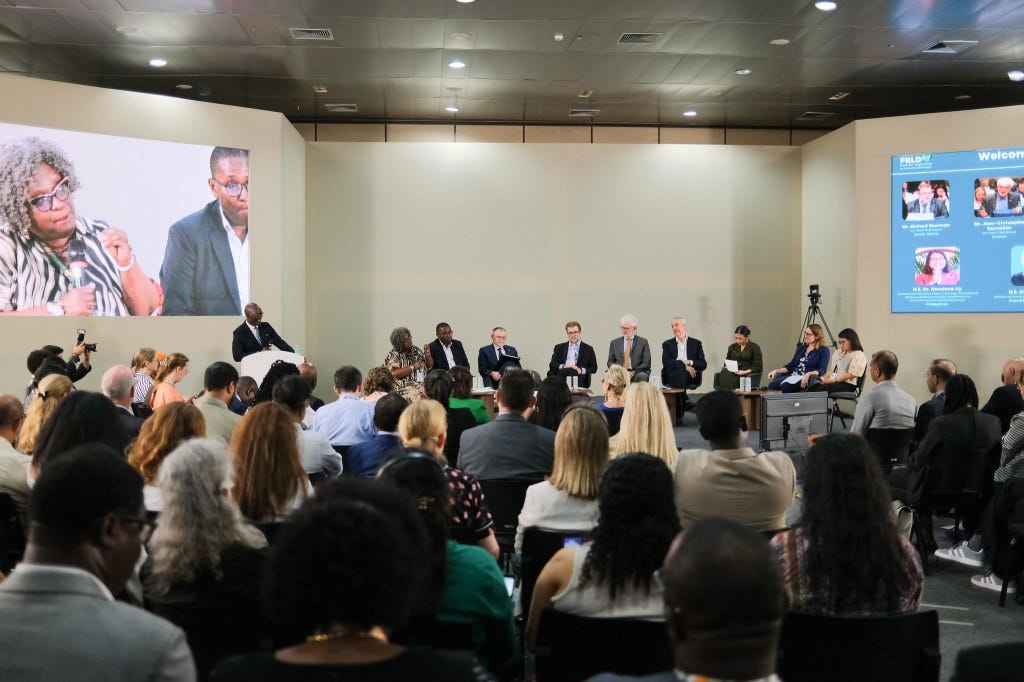
The COP30 opened with a series of high-level events centered on the them of Elevating Adaptation by Unleashing the Power of Technology. The opening day’s events included:
The Belém Declaration on Hunger, Poverty, and People-Centered Climate Action;
A commitment by multilateral development banks and the Climate Investment Funds to invest in accelerated adaptation and resilience measures;
A Green Digital Action Hub and commitment of $2.8 billion to innovation in agriculture and food systems;
RAIZ – The Resilient Agriculture Investment for net-Zero land degradation, to restore degraded lands.
The COP30 Presidency described the moment this way:
Day 1 of COP30 marks a turning point for adaptation and technology. Multilateral development banks and partners unveil new tools and financing models to turn adaptation plans into bankable, scalable projects, while a multi-billion-dollar agricultural innovation package is launched to help farmers in vulnerable regions adapt and thrive. In the afternoon, leaders from government, business, and the digital sector launch the Green Digital Action Hub, a global platform to drive a greener, more inclusive digital transformation.
Complications in this drive for enhanced access to actionable information include the rise of AI platforms, which hold promise and also create risks, and questions of open access and the many connections between technology and human rights. It is clear more people need good and useful information, and that access cannot require any trading away of basic rights.
So, principles are needed, and they need to attach to an overarching frame of reference for what success looks like. One of the tasks for the new AI Climate Institute will be to support development and adoption of standards and practices that prioritize quality of life benefits to vulnerable communities, while reducing the incentive for rapid deployment of unproven or error-prone systems.

Our relationship to Nature needs work sustainably. That work needs to be ethical, science-informed, and cooperative, and we need to move quickly to reduce harm caused by outmoded industrial systems that seek to exploit but not safeguard natural systems. As the UNDP report on the Nature Relationship Index found:
We need ecosystems that are thriving and sustainable.
We need societies that understand and honor the irreplaceable value of living systems, even as they interact with and make use of what Nature provides.
We need safeguards that prioritize zero harm to people and to natural systems.
To empower people across the diverse range of human experience, to adapt successfully, and to prevent danger and establish conditions for successful climate-resilient development, the zero harm standard must begin to play a constant role in the work of imagining the best possible future and working toward it, together.
As we noted at the end of the 2025 Reinventing Prosperity report Transcending Crisis: Invest to improve lives and livelihoods:
Give more people greater agency, in real terms, with everyday benefits to health and wellbeing, and we can achieve a world free from deprivation, conflict, and chaos.
Zero harm is the transformational goal. Everything else can be weighed for efficacy, legitimacy, and co-benefits on that scale.
