
Pearl Harbor reminds us why free people resist totalitarian terror & violence
84 years after Pearl Harbor, we remember the attack and the war that followed, but also the common cause and the institutions created to ensure the defense of the rights and dignity of all people.

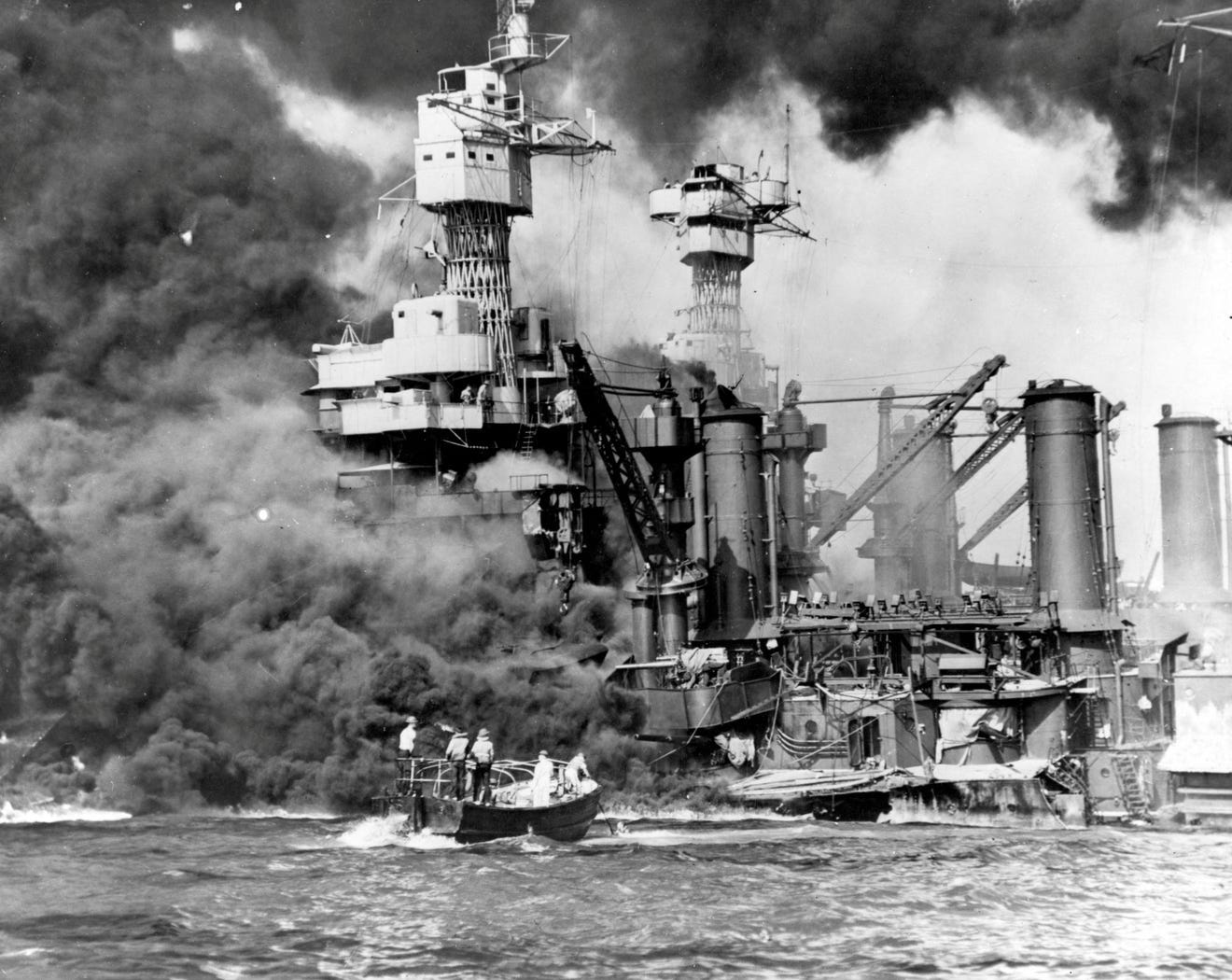
84 years ago yesterday, an unprovoked act of mass murder pulled the United States into the Second World War. Japanese war planes bombed the U.S. Pacific Fleet at Pearl Harbor, on the island of O’ahu, ostensibly to prevent the U.S. from resisting fascist and imperial takeovers in Europe and the Pacific. The effect was the opposite; the United States entered the war against the Axis Powers, and would fight two major wars on the other side of the Atlantic and Pacific Oceans.
What galvanized the American war effort, and made it possible to win both of those wars on foreign soil—brutal wars against highly industrialized, organized, and ruthless enemies, who would kill millions before it was over—was the commitment to fundamental human rights and the principle that governments work in service of sovereign people, not the other way around.
That the Axis Powers ran sadistic detention camps for slave labor and mass extermination made the cause all the more clear, and obviously existential. In Europe, existentialist philosophers admitted that we had not moved beyond good and evil, as many had hoped modernity would allow; they too would join the resistance of free people against ruthless evil. Free people would not be compelled by mass murderers to become slaves forced to support their own destruction.
Acts of heroic self-sacrifice and determined national defense, in the midst of attempted extermination, sparked a spirit of shared purpose. The brave sailors, soldiers, and other service people who resisted the bombardment at Pearl Harbor, or risked their lives to aid and rescue the wounded, deserve recognition and praise beyond what we can commonly conceive in our time.
The attack on Pearl Harbor came just 76 years after the end of the Civil War. Some would live through both wars. From 1941 through 1945, the American people would consciously fight to defend the principles laid out in The Declaration of Independence—that all people are created equal, entitled to dignity and security and the real protection of universal rights, which no power can legitimately reduce or extinguish.
That is the meaning of “unalienable”. No human being can be separated from their natural rights by any legitimate authority. That principle would later be enshrined as foundational national law, in the Ninth Amendment, which requires all who wield power in the United States to recognize and honor even those human rights that are not written explicitly into law.
Though fighting to uphold the rights of people in Europe, China, the Philippines, and elsewhere, to live free from violent tyranny, the Second World War was fought to defend The Bill of Rights. This is why in the aftermath of the war, the U.S. would lead a global effort to establish instruments of collaborative development, shared security, and open democracy.
The Universal Declaration of Human Rights recognizes “the inherent dignity and of the equal and inalienable rights of all members of the human family is the foundation of freedom, justice and peace in the world” and that “human rights should be protected by the rule of law”.
The United Nations was founded to manifest this vision of cooperation in service of human freedom, peace, and dignity. Its Charter opens with the words “We the Peoples” and recognizes a shared purpose:
to save succeeding generations from the scourge of war… to reaffirm faith in fundamental human rights, in the dignity and worth of the human person, in the equal rights of men and women and of nations large and small, and to establish conditions under which justice and respect for the obligations arising from treaties and other sources of international law can be maintained, and to promote social progress and better standards of life in larger freedom…
These were historic achievements for building the foundation for shared peace and prosperity. The shared goal—given that, in the three decades since 1914, two global wars and the hunger and disease outbreaks they set in motion, had taken more than 130 million lives—was to create, together, a future in which human rights and freedoms supersede any of the whims of those who wield power.
What the soldiers, sailors, and other service people who faced the terror of unprovoked aerial war at Pearl Harbor, demand we recognize is that the fundamental rights of free people are protected by the rule of law constraining the whims of those who would use power to harm others. Lawlessness in government is not only a sign of weakness; it is weakness of the most insidious and perilous kind, the kind that breaks nations and shatters their people’s plans for the future.
Leaders that embody and exhibit strength, and who deserve positions of leadership and the trust that allows them to wield power with legitimate authority, are loyal to the essential and transcendent human dignity of all people. They recognize that if they allow unlawful aims and actions to infiltrate their way of using public office, they weaken their country and betray their fellow citizens.
To be an American patriot, one must in one’s way resist and oppose authoritarianism, cruelty, corruption and lawlessness in public office. To be true to the spirit of 1776, 1865, and 1941, one must work intentionally to extend the spirit of the second half of the 20th century, in which the recognized global goal was to make the world safe for human rights and freedoms.
For much of the history of the American democratic republic, violent extremists intent on creating a totalitarian race-based theocracy have waged a low-grade terrorist war against the American people and their system of self-government—both before and after the Civil War. We must recognize how absolutely illegitimate is any person or entity that shows affinity for those violent extremists and their aim of subverting the rule of law and the Constitution’s guarantee of equal protection.
President John F. Kennedy—himself a veteran of the Second World War—called the United Nations “our last best hope in an age where the instruments of war have far outpaced the instruments of peace”. We do well today to hear Kennedy’s call for “a beachhead of cooperation [to] push back the jungle of suspicion… a new world of law, where the strong are just and the weak secure and the peace preserved.”