
Our planet is a watershed
Ten years after the Paris Agreement, we are still learning to value the integrated way in which natural systems create value. We need to accelerate our efforts to prevent unmanageable cost and chaos.

Review of climate resilient future prospects after the COP30 negotiations in Brazil, for St. John’s University course: Economics of Sustainable Development.
The COP28 in Dubai, in 2023, not only committed nations to “transitioning away from fossil fuels” but also expanded the Paris Agreement’s commitment on ecosystems, recognizing the importance of:
ensuring the integrity of all ecosystems, including in forests, the ocean, mountains and the cryosphere, and the protection of biodiversity...
As climate disruption gets worse, it is increasingy urgent that we turn that recognition to action. To ensure the integrity of all ecosystems in forests, the ocean, mountains, and the cryosphere, while protecting biodiversity, requires a level of climate action ambition beyond what any nation is currently envisioning.
Scientific evidence points to the glaring reality: without healthy ecosystems, without sufficient water, without intact mountain landscapes and a stable and reliable cryosphere, we will struggle to produce enough food for our still growing global population. A society without sufficient food is one that cannot maintain a functioning everyday economy.
Societal unraveling is likely closer than most people realize. We have moved beyond the time when the idea that wealth alone can provide protection against unchecked global change. The 2023 State of the Climate report found that:
By the end of this century, an estimated 3 to 6 billion individuals — approximately one-third to one-half of the global population — might find themselves confined beyond the livable region, encountering severe heat, limited food availability, and elevated mortality rates because of the effects of climate change...
Confined... beyond... the livable region...
A world in which billions of people cannot survive where they are is a world in which billions of people are fighting to survive, while seeking a new place to make a living and defend their family’s right to exist. Imagine a world where ten times the population of the United States is on the move, desperate for safety and opportunity, and equipped with technologies decades beyond what marginal communities can access today.
No nation has ever dealt with mass migration on that scale—even if we break down the total number into shares of refugee resettlement proportional to population. For instance, if the number is on the low end (3.3 billion) and the population reaches 10 billion by that time, that is a rate of 33%. For the United States, with a population of roughly 343 million:
A 33% share would amount to around 114 million people that would need to be absorbed;
If we consider the U.S. has 4% of the world’s population, that could mean 132 million new arrivals;
Using greenhouse gas emissions, where the U.S. is responsible for 12.6% of the global total, would equate to a refugee inflow of 415.8 million—far more than the total population of the country.
Each of these are clearly unmanageable numbers, so the only sensible course of action is fast-moving, widespread decarbonization, starting immediately.
We are living now in a crucial moment of choice, as multiple layers of international crisis come together to form a multidimensional polycrisis. The combined weight of climate disruption, pandemic ripple effects and wider public health crises, conflict, trade and protectionism, income inequality, the need for integrated solutions to thorny problems, and stresses on public budgets, not only degrades human security, but is driving a breakdown in trust that makes it harder to solve even routine problems.
Meanwhile, costs are mounting, fast. Beyond the $7 trillion per year spent to subsidize polluting energy systems, the world economy is bleeding $40 billion every day through unjust, unhealth, unsustainable food systems. The Food System Economics Commission finds we are spending about $15.43 trillion per year—a rate of waste that adds up to $607 billion from the opening of the COP30 on November 10 to this presentation on Nov 25.
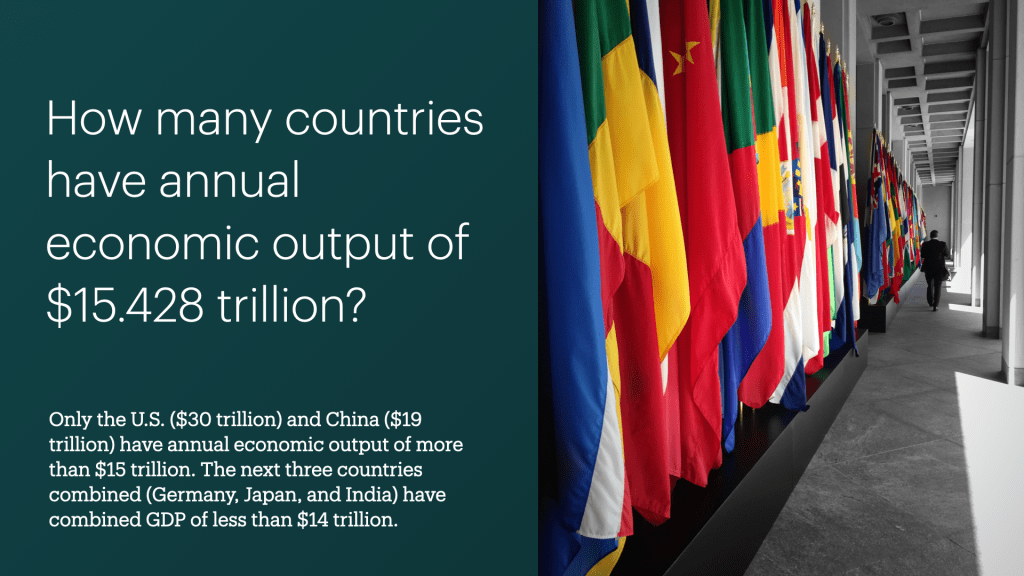
Only the United States ($30 trillion) and China ($19 trillion) have annual economic output (GDP) of more than $15 trillion. The next three countries combined (Germany, Japan, and India) have combined GDP of less than $14 trillion. Fiscal stability and security—at local and national levels—are at risk if we cannot get this pervasive systemic waste under control.
The EAT-Lancet Commission makes clear in its 2025 report: We can transition to food systems that are healthy, sustainable, and free from this devastating cost and waste. Doing so would improve lives and livelihoods, and would contribute to stabilizing our relationship with the climate system, possibly preventing much of the societal breakdown we are baking into our future.
An important breakthrough in the COP30 round of climate negotiations was the emphasis on multilevel climate governance. Local authorities working with regional governments, supporting locally rooted human development, can strengthen national climate action planning and implementation. Nations working together can enhance their collective capabilities.
The City Food Finance Principles point to high-value options for aligning budgets, investing in communities, improving health and wellbeing, and reducing fiscal stress:
Common Reality – Health-building, nutritious, sustainably produced food should be an affordable, accessible everyday option for all.
Delivering Impact – Cities deliberately play the role of impact investor, to shape healthy, sustainable food environments.
Urban-Rural Feedbacks – Cities work with surrounding rural areas to support convergence of consumption, production, and incentives.
Multilevel Cooperation – Cities engage with regional and national authorities to support enhanced implementation of national climate, food, health, and biodiversity plans.
Co-Investment – Cities engage proactively to shape and mobilize investment partnerships linked to a broader Co-Investment Platform for Food Systems Transformation.
Tracking and Labeling – Cities act as critical intermediaries to support needed data systems integration and multidimensional metrics.
The COP30 gave us a breakthrough commitment to prioritize and safeguard information integrity. To ensure more people have access to the benefits of the best available science, we must not only establish open information safeguards, but ensure information systems recognize the links between human rights, factual information, and human dignity and decent work—all of which are part of the process of avoiding underinformed decisions, preventable costs, and other destabilizing effects.

How this information filters down to the community level and into local economies will shape the fate of nations, including the ability of national governments to honor their legal obligation to prevent climate danger, as outlined in the landmark Advisory Opinion of the International Court of Justice. It will also shape the ability of communities, regions, and nations, to drive progress for their people in line with the 17 Sustainable Development Goals.
During the guest lecture, we invited students to outline projected future conditions, considering the above and responding to three motivational questions:
What will the world, or your community, be like in 2040? (Outline either Good with Bad or All Good scenarios.)
How can we get more of the Good? Back-casting from 2040 conditions, what action steps, policies, and innovations will move us from where we are to that better future?
How can we measure non-financial value and co-benefits, to drive this change?
Some of the insights students shared after their group exploration of future conditions were:
Protecting wildlife, ecosystems, and biodiversity will have significant long-term benefits for human health, security, and prosperity.
AI systems are growing fast. While this could be a hindrance to sustainable development, we should intentionally design and develop AI systems to be resource-efficient and to favor good outcomes for the health of people and Nature.
AI systems will also need to be developed to avoid using toxic chemicals that can pollute air an water.
Communities will have to proactively safeguard public “third spaces”, lest they be taken over by private interests; conservation can be both an urban and rural priority.
Metrics for measuring progress should include health outcomes, pollution of air and water, carbon emissions and carbon sequestration.
Cities and communities can play a leadership role, responding to and budgeting for local environmental health and climate resilience needs.
Communities should have cleaner air, more reliable access to fresh water, and a greater diversity of services, based on Earth systems insights and supporting human security and resilience.

This reflection from the 2025 Reinventing Prosperity report, Transcending Crisis, echoes much of the discussion of our future prospects for safe, secure, sustainable and shared prosperity:
Climate disruption is ongoing and getting worse, fast. Costs are piling up, and most institutions and communities are falling behind in terms of needed new infrastructure and business models to sustain local goods and services. This is affecting prices, readiness, resilience, and the innovation and adaptive capacity needed to navigate this time of polycrisis. Such costly inertia damages public trust and creates further political complications that slow or block urgently needed reforms.
Recognizing this aspect of the political trust dynamic is essential to finding the solutions that work in local context, to allow communities to thrive despite proliferating risks and costly destabilizing impacts. We need to get beyond the idea of “solutions” and shift to a mindset that favors adaptive systems design. That would mean local economies benefit from new financing attuned to local risk reduction and resilience needs. Such local economies also benefit from a wider range of activities being locally relevant, investable, and sustainable over time.
The Resilience Economy is an immense opportunity—to avoid senseless preventable harm and cost and to establish upgraded industrial and commercial systems that consistently add to the running reserve of resilience value on which all other value creation is founded. The key is to get started without further delay and to make sure we are making real progress.
